Moment Of Inertia Of A Rod About Its Center. The simple analogy is that of a rod. The moment of inertia of a uniform rod about an axis through its center is 1/12ml^2.the moment of inertia about an axis at one end is 1/3ml^2. What is the moment of inertia with respect to the end of the rod? Moment of inertia of rod about an axis through its center of mass and perpendicular to rod is a quantity expressing a body's tendency to resist angular acceleration, which is the sum of the products of the mass of each particle in the body with the square of its distance from the axis of rotation is calculated using moment of inertia = (mass *(length of rod ^2))/12. We found that the moment of inertia when the rod rotates about a parallel axis passing through the end of the rod is: Moment of inertia about an axis through its center of mass m : I = moment of inertia of the body i c = moment of inertia about the center m = mass of the body h 2 = square of the distance between 2 axes let us see how the parallel axis theorem helps us to determine the moment of inertia of a rod whose axis is parallel to the axis of the rod and it passes through the center of the rod. The rod is bent from the middle so that the two halves make an angle of 60 o. Its mass is, of course, the same. Moment of inertia about any parallel axis i cm: First use l = 120 cm to compute the moment of inertia i = ml 2 /12. First find the moment of inertia of the slender rod about a line l passing through its center of mass. Moment of inertia of rod about its end. 6) the moment of inertia of a uniform rod (about its center) is given by i = ml 2 /12. In this case, we use;
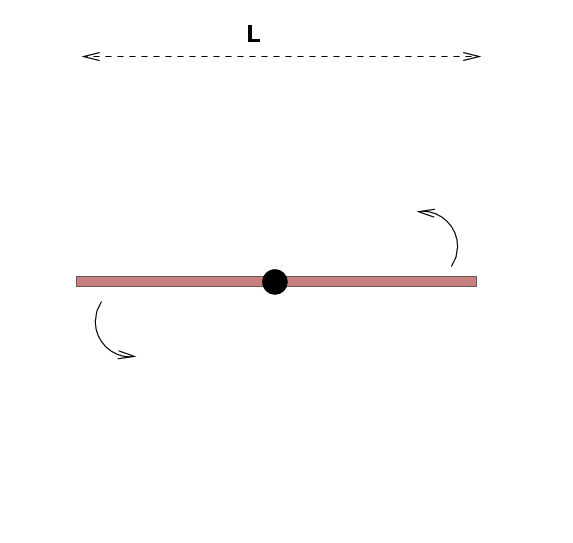
What's the moment of inertia of this rod? from spiff.rit.edu
I = ⅓ ml 2. Consider a differential element of length dr at a distance r from the center of mass. First find the moment of inertia of the slender rod about a line l passing through its center of mass. Moment of inertia of rod about its end. The moment of inertia of a rod about an axis through its centre and perpendicular to it is 121 ml2 (where m is the mass and l, the length of the rod). What is the moment of inertia with respect to the end of the rod? A rod of length l is rotated about its center which has a moment of inertia (1/12)ml? This is because the axis of rotation is closer to the center of mass of the system in (b). Explain why the moment of inertia is larger about the end than about the center. If the axis is through the end, it's (1/3)ml^2.
Moment Of Inertia Of A Uniform Rod Of Length.
The moment of inertia of a point mass is given by i = mr 2 , but the rod would have to be considered to be an infinite number of point masses, and each must be multiplied by the. I'm hoping there is no mistake in the above procedure. (treat it as a long uniform rod) homework equations i know that for long uniform rods with length l, if the axis is through the centre, the moment of inertia is (1/12)ml^2. A) 0.700 j b) 0.350 j c) 0.960 j d) 2.10 j e) 4.20 j answer: The moment of inertia about any axis parallel to that axis through the center of mass is given by i i md2 cm d i cm i cm i : What would be the moment of inertia of this bent rod about an axis perpendicular to the plane of the v at its vertex? If the axis is through the end, it's (1/3)ml^2. Total i = 2 (m/2) (ℓ/2)² / 3 = mℓ² / 12 Moment of inertia about an axis through its center of mass m :
Therefore, The Moment Of Inertia Of A Uniform Rod About A Perpendicular Bisector (I) = Ml 2 /12.
The simple analogy is that of a rod. Moment of inertia of a rod whose axis goes through the centre of the rod, having mass (m) and length (l) is generally expressed as; Consider a differential element of length dr at a distance r from the center of mass. I g = i c + ( ∫ 0 l k x d x) b 2, where b is the distance from center of mass to geometric center i.e. The moment of inertia about one end is [latex]\frac{1}{3}m{l}^{2}[/latex], but the moment of inertia through the center of mass along its length is [latex]\frac{1}{12}m{l}^{2}[/latex]. I = moment of inertia of the body i c = moment of inertia about the center m = mass of the body h 2 = square of the distance between 2 axes let us see how the parallel axis theorem helps us to determine the moment of inertia of a rod whose axis is parallel to the axis of the rod and it passes through the center of the rod. We take an infinitesimally small mass (dm) at a distance (x) from the origin. This is because the axis of rotation is closer to the center of mass of the system in (b). The similarity between the process of finding the moment of inertia of a rod about an axis through its middle and about an axis through its end is striking, and suggests that there might be a simpler method for determining the moment of inertia for a rod about any axis parallel to the axis through the center of mass.
4 M To A Uniform Sphere With Mass Ms = 33.
The moment of inertia of the bent rod about the same axis would be : A thin disk has b The moment of inertia can also be expressed using another formula when the axis of the rod goes through the end of the rod. After inserting these into the general integral, integrating, replacing λ with m/l and simplifying, we end up with the formula Moment of inertia about any parallel axis i cm: First find the moment of inertia of the slender rod about a line l passing through its center of mass. All the elements are at the same distance from the axis of. I c + ( ∫ 0 l k x d x). Moment of inertia of rod about its end.
What Is The Moment Of Inertia With Respect To The End Of The Rod?
In the first picture, there is a homogeneous metal rod of length 2 l and mass m. The attempt at a solution Slender means the length is much greater than the width or depth. Its mass is, of course, the same. I 1 = m ( 2 l) 2 12 = m l 2 3. I = (1/12) ml 2. If it rotates around a normal axis passing by o (which is the center of gravity), then its moment of inertia is: A 2 = ∫ 0 l k x. A rod of length l is rotated about its center which has a moment of inertia (1/12)ml?